Learning About Real Estate • October 7, 2026

What Is a Mortgage Rate Buydown and How Could It Help Buyers?

If you’ve been thinking about buying a home, you may have noticed that mortgage rates are higher than they were a few years ago.

And if higher rates have made you wonder whether you should put your home search on hold, you’re not alone.

But here’s the good news: a higher-rate environment doesn’t necessarily mean you have to stop looking.

There may be different strategies available that can help make the numbers more manageable. One option you may hear about from a lender is a mortgage rate buydown.

So, what is a mortgage rate buydown, how does it work, and could it make sense for you?

Let’s take a look.

What Is a Mortgage Rate Buydown?

A mortgage rate buydown is a way to reduce the interest rate on a mortgage, either temporarily or permanently, depending on the type of buydown.

The basic idea is simple: money is paid upfront to reduce the interest rate and, in turn, lower the mortgage payment.

There are different types of rate buydowns, so it’s important to understand which option you’re being offered and how the numbers work.

A lender can show you the specific terms, costs and potential savings based on your loan.

What Is a Temporary Mortgage Rate Buydown?

One type of buydown is a temporary rate buydown.

For example, you may hear about a 2-1 buydown.

With a 2-1 buydown, the interest rate is temporarily reduced during the first year and reduced again during the second year before returning to the permanent note rate.

The exact structure, costs and eligibility requirements can vary depending on the loan and transaction.

The Consumer Financial Protection Bureau explains that temporary buydowns can lower a borrower’s payment for a limited period, often one to three years, before the payment returns to the regular amount.

That means buyers considering a temporary buydown should make sure they are comfortable with the payment that will apply after the temporary period ends.

What About Buying Down the Rate Permanently?

Another option is paying discount points, sometimes called mortgage points, to reduce the interest rate for the life of the loan.

Generally, one discount point costs 1% of the loan amount, although the amount that one point reduces the interest rate can vary based on the lender, loan type and market conditions.

For example, if your loan amount were $300,000, one point would generally cost $3,000.

That doesn’t automatically mean paying $3,000 is the right decision.

The important question is whether the upfront cost makes sense compared with the monthly savings you expect to receive.

The CFPB recommends comparing mortgage options with and without points or lender credits and considering factors such as your upfront costs, monthly payment and how long you expect to have the loan.

Who Pays for a Mortgage Rate Buydown?

Depending on the loan and transaction, the cost of a rate buydown may potentially be paid by the buyer, seller or another permitted party.

For example, a seller may agree to contribute toward certain buyer costs as part of the transaction, if allowed under the applicable loan guidelines.

There are limits and requirements that can apply, so this is something you should discuss with your lender and real estate agent before assuming a particular arrangement will be allowed.

Could a Rate Buydown Help in Today’s Market?

This is where I think rate buydowns are worth understanding.

If you’re financially ready to buy but today’s mortgage payment is making you hesitate, a rate buydown may be one option worth discussing with your lender.

It doesn’t mean you have to buy a home you can’t afford.

It doesn’t mean a buydown is automatically better than waiting.

And it doesn’t mean every buyer will benefit from one.

But it does give you another option to consider when you’re looking at the overall cost of purchasing a home.

Instead of simply asking, “What is today’s interest rate?” it can be helpful to ask:

“What options are available to help make this payment work for me?”

That’s a conversation worth having with your lender.

Is a Rate Buydown Always a Good Deal?

Not necessarily.

A rate buydown has a cost, and you want to understand what you’re getting in return.

For example, if you’re paying several thousand dollars upfront to reduce your monthly payment, you’ll want to know how long it will take for those monthly savings to make up for the upfront expense.

This is often referred to as the break-even point.

You should also consider how long you expect to own the home or keep the mortgage.

If you sell or refinance before reaching your break-even point, you may not receive the full financial benefit you expected.

That’s why it’s important to compare the numbers rather than assuming a lower rate automatically means a better deal.

What Should You Ask Your Lender?

If you’re considering a mortgage rate buydown, here are some questions to ask:

What would my payment be without the buydown?

What would my payment be with the buydown?

How much would the buydown cost upfront?

Who would be paying for it?

How long would the reduced rate last?

What will my payment be after the temporary buydown ends?

How long would it take for the savings to offset the upfront cost?

How does this compare with simply accepting the current rate?

Your lender can run the actual numbers based on your loan amount, credit profile, down payment and other factors.

The CFPB also recommends comparing your loan options carefully, including the interest rate, monthly payment, points, fees and cash needed to close.

A Buydown Doesn’t Replace a Realistic Home Budget

This is important.

A mortgage rate buydown can potentially make the payment more manageable, but it shouldn’t be used to stretch your budget beyond what you’re comfortable with.

You still need to consider the entire cost of homeownership, including your mortgage payment, property taxes, homeowners insurance, mortgage insurance if applicable, HOA fees, utilities, maintenance and other financial obligations.

The goal isn’t simply to find a way to qualify for a particular home.

The goal is to find a home that fits your overall financial picture and your life.

Want to See What the Numbers Could Look Like?

Sometimes the easiest way to understand a mortgage rate buydown is to see the numbers side by side.

I have a helpful comparison from one of my lending partners that shows how a mortgage rate buydown could affect the monthly payment compared with lowering the purchase price of the home.

If you’d like to see a real-world example and better understand how these two options can affect your payment, reach out to me and I’ll be happy to share the comparison with you.

It can be helpful to see the numbers before deciding which option may make sense for your situation.

The Bottom Line

Higher mortgage rates can make buying a home more challenging, but they don’t necessarily mean you have to put your plans on hold.

A mortgage rate buydown may be one tool that can help make today’s market more manageable, depending on your loan, financial situation and the specific transaction.

The key is to understand your options and look at the actual numbers.

You don’t have to assume that you need to wait for the “perfect” interest rate before exploring your options. Instead, talk with your lender, compare different scenarios and determine what makes sense for your financial situation.

And remember, the right decision isn’t necessarily the one with the lowest rate. It’s the one that makes sense for your budget, your goals and your plans for the home.

If you’re thinking about buying a home in Lexington, Columbia or surrounding areas of the Midlands of South Carolina, I’m here to help you navigate the real estate side of the process and connect you with trusted professionals who can help you understand the financing options available to you.

Make Moves with Faith
Faith Morris | ERA Wilder Realty
Serving Lexington, Columbia & the Midlands of South Carolina

This article is for educational purposes only and is not financial or mortgage advice. Mortgage rates, loan programs, eligibility requirements, costs and contribution limits vary. Speak with a qualified lender about your specific situation.

Learning About Real Estate • October 7, 2026

Should You Buy a Home When Mortgage Rates Are High?

Should You Buy a Home When Mortgage Rates Are High?

If you’ve been thinking about buying a home, you’ve probably heard a lot about mortgage rates.

Maybe you’ve thought:

“I want to buy a house, but I’m going to wait until rates come down.”

That’s understandable.

Your mortgage rate can have a significant impact on your monthly payment and the overall cost of borrowing.

But there’s another question worth asking:

Is waiting for a lower rate always the best choice for you?

The answer isn’t the same for every buyer.

Let’s look at some of the things you should consider before deciding whether to buy now or wait.

First, What Does a Higher Mortgage Rate Actually Mean?

Your mortgage interest rate affects how much interest you pay to borrow money for your home.

Generally, a higher interest rate means a higher monthly principal-and-interest payment than you would have with a lower rate on the same loan amount.

But your mortgage payment isn’t determined by the interest rate alone.

Your payment can also be affected by the purchase price, down payment, loan type, property taxes, homeowners’ insurance and, when applicable, mortgage insurance or HOA fees.

That’s why looking at the rate by itself doesn’t tell you the complete affordability picture.

Should You Wait for Rates to Come Down?

This is one of the biggest questions buyers have.

The challenge is that no one can guarantee when mortgage rates will fall, how much they will fall or what home prices will look like when they do.

Waiting could result in a lower rate.

But it could also mean that home prices, inventory or competition change while you’re waiting.

And if rates fall significantly in the future, you may have an opportunity to explore refinancing if you qualify and if refinancing makes financial sense at that time.

In other words, buying a home doesn’t necessarily mean you’re permanently locked into today’s financial environment.

What If Home Prices Increase While You’re Waiting?

This is another part of the conversation that often gets overlooked.

Suppose you’re waiting because you don’t like today’s mortgage rates.

During that time, the price of the type of home you’re looking for could increase.

Even if you eventually get a lower interest rate, you could be borrowing more money because the home costs more.

That’s why buyers should look at the entire housing market and their personal situation, rather than focusing on one number.

What If Mortgage Rates Go Down After You Buy?

This is where the possibility of refinancing may come into the conversation.

If mortgage rates decline substantially after you purchase your home, you may eventually consider refinancing.

However, refinancing isn’t automatic and isn’t always the right financial decision.

There can be closing costs and other expenses associated with refinancing, and you’ll need to qualify based on the lender’s requirements at that time.

So don’t buy a home assuming that you’ll definitely be able to refinance later.

Instead, make sure the home and payment make sense based on your situation today.

What Should You Consider Before Buying?

Instead of asking only, “Are mortgage rates too high?”, consider the bigger picture.

Can You Comfortably Afford the Payment?

Look at the estimated total monthly housing expense, not just principal and interest.

Consider taxes, insurance, mortgage insurance, HOA fees and other applicable costs.

You don’t want to stretch your budget so far that homeownership becomes stressful.

How Long Do You Expect to Stay?

Your plans matter.

If you’re buying a home that you expect to live in for several years, your decision may look different than it would if you’re only expecting to stay for a short period.

There’s no magic number of years that makes buying automatically right or wrong.

Your circumstances matter.

Have You Found the Right Home?

Sometimes buyers become so focused on the rate that they forget about the actual home.

Does the property fit your needs?

Is the location right for your lifestyle?

Does the price make sense for the market and your budget?

Would you still want the home if mortgage rates stayed where they are for a while?

Those are important questions.

Are You Financially Prepared?

Before buying, consider whether you’re prepared for more than the down payment.

You may need money for closing costs, moving expenses, inspections and other homeownership costs.

You also want to consider whether you’ll have enough financial breathing room after closing.

A lower rate doesn’t make a purchase affordable if you’re financially unprepared for homeownership.

What If You’re a First-Time Buyer?

If you’re a first-time buyer, today’s rates may feel intimidating.

But don’t assume that you have to wait until everything is perfect.

There may be different loan programs, down payment options and assistance programs that could affect how much cash you need upfront.

Your mortgage professional can help you compare the options you’re eligible for and explain how different rates and loan structures affect your payment.

The Bottom Line

There isn’t one universal answer to the question:

“Should I buy a home when mortgage rates are high?”

For some buyers, waiting may make sense.

For others, buying now may make sense based on their income, finances, housing needs, available inventory and long-term plans.

The important thing is not to make the decision based on one number alone.

Look at the purchase price, monthly payment, your financial goals, your expected timeline and the overall housing market.

And if you decide to buy, make sure the home is affordable without relying on the hope that mortgage rates will change later.

The right time to buy isn’t simply when rates are at their lowest. It’s when the purchase makes sense for your overall financial situation and your life.

Ready to Make Your Move?

If you’re considering buying a home in Lexington or the Midlands of South Carolina, I’m here to help you understand the process, explore your options and connect you with the professionals you need to make an informed decision.

Make Moves with Faith
Faith Morris | ERA Wilder Realty
Serving Lexington & the Midlands of South Carolina

📩 Thinking about buying but wondering whether now is the right time? Let’s talk about your options.

This information is for educational purposes only and is not financial or lending advice. Mortgage rates, loan requirements, home prices and individual financial circumstances vary. Speak with a qualified mortgage professional about your specific situation.

Learning About Real Estate • October 6, 2026

How Much House Can I Afford Without Becoming House Poor?

Getting approved for a mortgage can feel like a huge milestone.

But there’s an important question to ask before you start shopping:

Just because a lender says you can afford a certain amount doesn’t necessarily mean you should spend that much.

Buying a home is about more than qualifying for a mortgage. You also have to think about your everyday expenses, future goals, maintenance, utilities and the unexpected costs that come with owning a home.

The goal isn’t simply to buy the most expensive home you qualify for.

The goal is to buy a home you can comfortably afford while still being able to enjoy your life.

What Does “House Poor” Mean?

Being house poor generally means that too much of your income is going toward your housing expenses, leaving you with little money for everything else.

You may technically be able to make the mortgage payment, but you could find yourself constantly worrying about money.

That can make homeownership feel more stressful than rewarding.

Before deciding on a price range, consider the full picture of your finances.

Don’t Look Only at the Mortgage Payment

When people think about affordability, they often focus on the principal and interest portion of the mortgage.

But your total monthly housing expense can include much more.

Depending on your situation, you may need to account for principal and interest, property taxes, homeowners insurance, mortgage insurance, HOA fees and other property-related expenses.

For example, a home with a lower purchase price could still have a higher monthly payment if it has higher property taxes, insurance or HOA fees.

That’s why looking at the purchase price alone doesn’t tell the whole story.

What Other Expenses Should You Consider?

Your housing payment is only one part of your monthly budget.

Think about what you already spend on car payments, student loans, credit cards, groceries, utilities, childcare, insurance, transportation, subscriptions and other regular expenses.

Then consider the costs that come with owning a home.

You may eventually need to pay for routine maintenance, landscaping, appliance repairs, HVAC service, plumbing issues or other unexpected repairs.

Your budget should leave you enough room to handle these expenses without putting every unexpected bill on a credit card.

What About Your Other Financial Goals?

Buying a home shouldn’t necessarily mean putting every other financial goal on hold.

Before choosing your price range, think about whether you want to continue saving for retirement, building an emergency fund, paying down debt, saving for your children’s education, traveling or preparing for other major expenses.

A home is an important investment, but it is still part of your overall financial picture.

A Mortgage Pre-Approval Is a Starting Point, Not a Spending Target

A pre-approval tells you how much a lender may be willing to lend based on information such as your income, credit profile, debts and other financial factors.

But your personal comfort level may be different from the lender’s maximum approval amount.

That’s an important distinction.

If you’re pre-approved for $400,000, that doesn’t automatically mean a $400,000 home is the right choice for your budget.

You may decide that a lower price gives you more breathing room each month.

And there’s nothing wrong with that.

How Can You Figure Out What You Can Comfortably Afford?

Start with your actual monthly budget rather than starting with the maximum home price.

Look at your current income and expenses, then consider what your estimated total housing payment would be.

You can also use the Consumer Financial Protection Bureau’s home loan resources to learn more about mortgage payments, loan costs and the home-buying process.

It’s also important to talk with your lender about what your estimated payment could look like at different purchase prices.

For example, instead of asking only:

“How much can I get approved for?”

Consider asking:

“What would my monthly payment look like at $250,000, $300,000 and $350,000?”

Seeing the difference can help you determine what feels comfortable.

Don’t Forget About the Costs After You Buy

One of the biggest mistakes buyers can make is using nearly all of their available cash just to get to the closing table.

Homeownership doesn’t stop being expensive once you receive the keys.

You could move in and discover that the house needs a new appliance, minor repair, furniture, landscaping or another unexpected expense.

That doesn’t mean you should be afraid to buy.

It simply means your budget should account for life after closing, too.

The Bottom Line

The right home isn’t necessarily the most expensive home you can qualify for.

It’s the home that fits your income, expenses, financial goals and lifestyle without making you feel financially stretched every month.

Before you fall in love with a house, make sure you understand what the monthly payment could look like and whether that payment fits comfortably into your life.

Buying a home should give you a place to build your life, not make you feel like you’re constantly trying to keep up with your mortgage.

If you’re thinking about buying a home in Lexington or the Midlands of South Carolina, I’m happy to help you understand the home-buying process and connect you with the right professionals to help you determine what fits your situation.

Make Moves with Faith
Faith Morris | ERA Wilder Realty
Serving Lexington & the Midlands of South Carolina

📩 Thinking about buying but not sure what price range makes sense for you? Let’s talk about your next move.

This information is for educational purposes only and is not financial or lending advice. Mortgage qualifications, interest rates, taxes, insurance and other costs vary by buyer and property. Speak with a qualified mortgage professional about your specific situation.

Learning About Real Estate • October 5, 2026

What Are Closing Costs and How Much Should Buyers Budget?

You’ve found the house.

You’ve figured out your down payment.

You’ve gotten pre-approved.

Then someone mentions closing costs.

And suddenly you’re wondering:

“Wait…what else do I have to pay for?” 😅

Closing costs are one of those parts of buying a home that can catch buyers off guard if they haven’t planned for them.

The good news is that understanding them ahead of time can make the home-buying process feel a lot less overwhelming.

So, how much are closing costs when buying a home?

Let’s break it down.

What Are Closing Costs?

Closing costs are the various expenses associated with getting your mortgage and completing your home purchase.

They are separate from your down payment.

According to the Consumer Financial Protection Bureau, closing costs can include expenses such as lender charges, appraisal fees, title services, government taxes and recording fees, prepaid interest, homeowners insurance and initial escrow deposits. Your actual costs will depend on your loan, property and transaction.

A commonly used planning range is about 2% to 5% of the purchase price, but this is only a general estimate. Your actual closing costs could be higher or lower.

For example, if you’re purchasing a $300,000 home, 2% to 5% would be approximately:

2% = $6,000

3% = $9,000

4% = $12,000

5% = $15,000

That’s a planning range, not a quote.

Your actual closing costs will depend on your individual loan and transaction.

What Do Closing Costs Include?

Closing costs aren’t just one single fee.

They can include several different expenses connected to your mortgage and purchase.

Some common costs may include lender or origination charges, appraisal fees, title services, title insurance, government recording charges, prepaid interest, homeowners insurance and initial escrow deposits for property taxes and insurance.

Depending on your loan and transaction, there may also be other costs.

That’s why it’s important to look at the actual numbers for your specific purchase rather than simply assuming you’ll pay a certain percentage.

Closing Costs Are Not the Same as Your Down Payment

This is an important distinction for buyers.

Your down payment is the amount you’re putting toward the purchase price of the home.

Your closing costs are the other expenses associated with getting the loan and completing the transaction.

For example, let’s say you’re purchasing a $300,000 home and putting 5% down.

Your down payment would be:

$15,000

If your estimated closing costs were 3%:

$9,000

That doesn’t necessarily mean you will need exactly $24,000 in cash at closing.

There may be earnest money you’ve already paid, seller credits, lender credits or other adjustments that affect the amount you’ll actually need to bring to closing. The CFPB’s Loan Estimate Explainer shows how these credits and deposits can affect your estimated cash to close.

Your lender will provide estimates based on your specific loan.

What Is a Loan Estimate?

If you’re getting a mortgage, one of the most important documents you’ll receive early in the process is your Loan Estimate.

A Loan Estimate provides important information about your loan, including your estimated interest rate, monthly payment and closing costs.

It’s designed to help you understand the costs of your mortgage and compare loan offers.

When reviewing your Loan Estimate, don’t just look at the bottom-line number.

Review the individual costs and ask questions about anything you don’t understand.

The CFPB also provides a Loan Estimate Explainer that walks through the different sections of the form.

Can Your Closing Costs Be Covered?

Here’s something buyers don’t always realize:

You may not always have to pay all of your closing costs out of your own savings.

Depending on your loan program and the details of the transaction, there may be ways to reduce the amount you need to pay out of pocket.

For example, some buyers may qualify for down payment or closing-cost assistance programs. Certain loan programs may also allow eligible costs to be covered through approved sources of funds.

Another possibility is seller credits.

As part of your offer negotiations, you may be able to ask the seller to contribute toward certain closing costs.

Whether a seller agrees can depend on the market, the terms of your offer and the seller’s situation. The CFPB explains that seller credits can be used to offset certain closing costs, but the details depend on the transaction and applicable rules.

There are also limits on how much a seller can contribute, and those limits can vary depending on the type of mortgage you’re using.

That’s why it’s important to talk with your lender before assuming you’ll need to bring the entire amount of your estimated closing costs to the closing table.

What About Lender Credits?

You may also hear about lender credits.

A lender credit can help reduce the amount you pay upfront toward closing costs.

But there can be a trade-off.

Lender credits generally reduce your closing costs upfront in exchange for a higher interest rate.

That doesn’t automatically mean lender credits are good or bad.

It means you should understand the numbers and compare your options before deciding.

The CFPB recommends comparing loan options with and without points or credits so you can see how they affect your cash needed at closing, monthly payment and overall borrowing costs.

Sometimes reducing your upfront costs makes sense.

Sometimes another option may be better.

The right choice depends on your situation.

Does That Mean You Don’t Need Money Saved?

Not necessarily.

Even if you’re able to use assistance, seller credits or other options to reduce your closing costs, you should still understand exactly what expenses you’ll be responsible for.

Your lender can help you determine your estimated cash to close, which is the amount you’ll actually need to bring to closing after accounting for things such as your down payment, closing costs, deposits and applicable credits.

The goal isn’t to assume someone else will pay your closing costs.

The goal is to know your options before you get there.

How Can Buyers Prepare for Closing Costs?

The best way to avoid surprises is to start asking questions early.

Before you begin seriously shopping for a home, talk with your lender about what your estimated closing costs could look like based on your price range and loan program.

As you move through the mortgage process, review the estimates your lender provides and ask questions about anything you don’t understand.

You can also ask about available down payment assistance, closing-cost assistance, seller credits and lender credits and how those options could affect your overall costs.

The more you understand before making an offer, the better prepared you’ll be to make informed decisions.

The Bottom Line

Closing costs are an important part of buying a home, but they don’t have to be a surprise.

Understand what they are, know what they may include, and most importantly, ask about your options.

Depending on your situation, there may be ways to reduce the amount you have to pay out of pocket through eligible assistance programs, seller credits or other financing options.

Before you start house hunting, make sure you understand your down payment, your estimated closing costs and your potential cash to close.

Because knowing your numbers before you make an offer can make the road to the closing table a whole lot less stressful. 🏡

Make Moves with Faith

Faith Morris | ERA Wilder Realty
Serving Lexington & the Midlands of South Carolina

Thinking about buying a home and not sure where to start?

Let’s talk about your next move.


Closing costs, loan requirements, fees and available credits can vary based on the property, loan program, lender and individual transaction. This article is for educational purposes only and is not a guarantee of loan approval or specific costs. Buyers should consult with their lender for an estimate based on their individual situation.

Learning About Real Estate • October 4, 2026

What Credit Score Do You Need to Buy a House?

What Credit Score Do You Need to Buy a House?

One of the first questions many people ask when they start thinking about buying a home is:

“Is my credit score good enough to buy a house?”

The good news is that there isn’t one magic credit score that automatically determines whether you can become a homeowner.

Different mortgage programs have different requirements, and lenders may have their own guidelines. Your credit score is important, but it’s only one part of the overall picture. Your income, debt, savings, down payment, employment history and the type of loan you’re using can all play a role in qualifying for a mortgage.

So, what credit score do you actually need?

Let’s break it down.

Credit Score Guidelines by Loan Type

Here’s a general look at the credit score guidelines you may encounter when exploring some of the most common mortgage options.

Loan Type Credit Score Guideline
Conventional 620+ is preferred, although some of their loan programs may allow lower scores
FHA Around 580 is typically required; some FHA options may allow lower scores with a larger down payment
VA No minimum credit score set by the VA, although the lender may have its own requirements
USDA Credit requirements vary based on the loan, lender and overall financial profile

These numbers are guidelines, not guarantees. Your lender will look at your complete financial picture, and requirements can vary by loan program and lender.

Does a Higher Credit Score Help?

Generally, yes.

Your credit score can affect both your ability to qualify for a mortgage and the interest rate you may receive.

A stronger credit profile can give you more loan options and may help you qualify for better terms. But your credit score isn’t the only factor a lender considers.

Your income, existing debt, savings, assets, down payment and credit history can also affect your mortgage application.

That’s why I don’t recommend looking at your credit score by itself and deciding, “I can’t buy a house.”

There may be options you haven’t explored yet.

What If Your Credit Score Isn’t Where You Want It to Be?

Don’t panic.

If you’re thinking about buying a home but your credit score isn’t quite where you’d like it to be, you may have time to work on it before you purchase.

Start by reviewing your credit reports for errors or accounts you don’t recognize.

You can get your credit reports through AnnualCreditReport.com, the official source for free credit reports.

Checking your own credit report does not hurt your credit score.

Look carefully for incorrect information, late payments that aren’t accurate, accounts that don’t belong to you, duplicate accounts or other errors.

If you find something that isn’t correct, you can dispute the information with the appropriate credit reporting company.

A Few Things You Can Do Before Applying for a Mortgage

If buying a home is somewhere on your future list, your credit deserves some attention well before you’re ready to make an offer.

Focus on paying your bills on time, keeping credit card balances under control, avoiding unnecessary new credit accounts and reviewing your credit reports regularly.

And remember, don’t make major financial changes right before buying a home without talking to your lender first.

Opening new credit accounts, financing a vehicle or taking on additional debt can affect your credit profile and your ability to qualify for a mortgage.

You Don’t Have Just One Credit Score

Here’s something many future homebuyers don’t realize:

You can have more than one credit score.

Different scoring models and credit reporting companies can produce different scores. The score you see through a credit card company or another service may not be exactly the same score a mortgage lender uses.

That’s another reason not to assume that one number tells you whether you can buy a home.

Instead of asking only, “Is my credit score high enough?”, a better question is:

“What mortgage options might I qualify for based on my complete financial picture?”

That’s a conversation worth having with a mortgage professional.

What About First-Time Homebuyers?

If you’re a first-time buyer, don’t let a credit score that isn’t perfect stop you from learning about your options.

There are mortgage programs designed to accommodate different financial situations, including FHA, VA, USDA and conventional financing.

Resource Financial Services notes that its first-time homebuyer options include FHA loans with more flexible credit requirements, VA loans for eligible veterans and service members, USDA financing with low or no down payment options for eligible buyers, and conventional financing.

Your next step doesn’t necessarily have to be “start house hunting.”

Sometimes the first step is simply finding out where you stand.

Before You Apply, Check Your Credit

If homeownership is a goal for you, give yourself time to prepare.

Review your credit reports, understand your current debt, look at your savings and talk with a qualified mortgage professional about your options.

The Consumer Financial Protection Bureau’s mortgage resources are also a helpful place to learn more about credit, mortgages and preparing to buy a home.

The Bottom Line

So, what credit score do you need to buy a house?

There isn’t one universal number.

A 620 score is a commonly used benchmark for conventional financing, and Resource Financial Services says it prefers a score of at least 620 for conventional loans. Other loan programs may allow different credit profiles.

The most important thing is not to count yourself out before you know your options.

Your credit score is one piece of the home-buying puzzle.

Know your numbers. Understand your options. Then make a plan.

And if buying a home is part of your future, I’m always happy to help you understand the real estate side of the process and connect you with the right professionals along the way.

Make Moves with Faith 🏡

Faith Morris | ERA Wilder Realty
Serving Lexington & the Midlands of South Carolina

Ready to start planning your next move?
Let’s connect and talk about your goals.


Mortgage requirements, credit score guidelines and loan programs can change. Individual lenders may have additional requirements, and approval is based on the borrower’s complete financial profile. This article is for educational purposes and is not a guarantee of loan approval or mortgage terms.

Learning About Real Estate • October 2, 2026

How Much Money Do You Really Need to Buy a Home? A Buyer’s Guide

One of the biggest questions I hear from people thinking about buying a home is:

“How much money do I actually need to have saved?”

And one of the biggest misconceptions is that you need 20% down before you can even start thinking about buying.

The truth is, the amount of money you need to buy a home depends on several factors, including your loan program, purchase price, closing costs, earnest money, moving expenses, and how much money you want to keep in savings after you close.

So, let’s break it down.

💰 1. Your Down Payment

Your down payment is usually the first expense people think about when they ask, “How much money do you need to buy a home?”

But you don’t necessarily need 20%.

Depending on your situation and the loan program you qualify for, your down payment could be considerably less.

For example, on a $300,000 home, here’s what different down payments could look like:

Down Payment Approximate Amount
0% $0
3% $9,000
3.5% $10,500
5% $15,000
10% $30,000
20% $60,000

The amount you need depends on the loan program and lender requirements. The Consumer Financial Protection Bureau explains that there are many different down payment options, and some loan programs allow buyers to put down considerably less than 20%.

For more information about planning your down payment and determining what you can comfortably afford, check out the Consumer Financial Protection Bureau’s guide to figuring out how much you want to spend on a home.

🏡 USDA Loans: Could You Buy With No Down Payment?

For some eligible buyers, a USDA loan may provide an opportunity to purchase a home with 100% financing, meaning a down payment may not be required.

However, USDA loans aren’t available for every buyer or every property. Eligibility depends on factors such as the property’s location, household income, occupancy requirements, and other program requirements.

If you’re considering a home in an eligible area, you can learn more about the USDA Rural Development Single Family Housing Guaranteed Loan Program.

⭐ Veterans and Active-Duty Service Members

If you’re a Veteran or active-duty service member, don’t automatically assume you need a large down payment to become a homeowner.

Eligible borrowers using a VA-backed purchase loan may be able to purchase a home with no down payment, when the program and lender requirements are met. The VA says nearly 90% of VA-backed loans are made with no down payment.

You can learn more about eligibility and the VA-backed purchase loan through the U.S. Department of Veterans Affairs.

But here’s something important:

Zero down does NOT necessarily mean zero money needed.

Even if your loan doesn’t require a down payment, you may still have other expenses to consider, including closing costs, earnest money, inspections, moving expenses, prepaid expenses, and other costs associated with buying a home.

That’s why it’s important to look at the whole picture, not just the down payment.


💵 2. Earnest Money

Another expense buyers should understand is earnest money.

Earnest money is a deposit a buyer may make after an offer is accepted to show the seller that they’re serious about purchasing the home.

It’s important to understand that earnest money is not usually an additional expense on top of your purchase price.

When properly applied at closing, it is generally credited toward your purchase costs, such as your down payment or other amounts due at closing.

The amount of earnest money can vary depending on the transaction and the terms of the contract.

It’s also important to understand when the earnest money is due, where it will be held, how it will be handled at closing, under what circumstances it may be refundable, and when it could potentially be at risk.

The exact terms depend on the contract and circumstances of the transaction.

For buyers, the important takeaway is:

You may need cash available before you ever get to closing.

That’s why it’s important to understand your anticipated upfront costs before you start making offers.

Your real estate agent can explain the contractual terms, while your lender can help you understand how the earnest money will be reflected in your overall cash-to-close.


💳 3. Closing Costs

Closing costs are another important part of the answer to “How much money do I need to buy a home?”

Closing costs are separate from your down payment and can include expenses such as loan-related fees, appraisal, title-related expenses, recording fees, prepaid property taxes, homeowners insurance, prepaid interest, and other transaction-related expenses.

The amount you’ll pay can vary depending on the purchase price, loan type, lender, property, location, and specific terms of your transaction.

As a general planning guideline, the Consumer Financial Protection Bureau says closing costs typically range from 2% to 5% of the purchase price, not including the down payment. However, your actual costs may be higher or lower.

For example, on a $300,000 home, 2% to 5% would be approximately $6,000 to $15,000.

That’s only a planning estimate, not a quote.

Your lender will provide a more specific estimate based on your loan and transaction.

As you move through the mortgage process, your Loan Estimate will give you a clearer picture of the costs associated with your loan.

You can also use the Consumer Financial Protection Bureau’s Loan Estimate guide to help you understand the information you’ll receive.


🚚 4. Moving Expenses

It’s easy to focus so much on buying the house that you forget about actually moving into it.

Depending on your situation, you may need money for a moving company or truck rental, packing supplies, temporary storage, utility deposits, temporary housing, travel expenses, new furniture, cleaning, and other moving-related expenses.

And if you’re relocating from another state to South Carolina, these expenses can add up quickly.

This is one reason I encourage buyers to think beyond the amount they need to bring to closing.

The CFPB recommends accounting for moving costs, furnishings, renovations, and an emergency cushion when determining how much cash you actually have available for your purchase.


🔨 5. Immediate Home Expenses

Even a home that looks move-in ready may have expenses after you receive the keys.

You may want to budget for changing locks, basic tools, cleaning supplies, minor repairs, painting, appliances, window coverings, landscaping, furniture, and home maintenance.

You don’t have to do everything at once.

But having some money available after closing can make the transition much less stressful.


🏦 6. Your Emergency Cushion

This is one of the areas I don’t want buyers to overlook.

Just because you can use all of your savings to purchase a home doesn’t necessarily mean you should.

Homeownership comes with ongoing expenses, and unexpected things can happen.

The CFPB recommends setting aside an emergency cushion, with a general rule of thumb of at least three to six months of expenses, when determining how much money you can comfortably use toward purchasing a home.

You don’t want to walk away from the closing table with a beautiful new home but nothing left in your savings account.

Give yourself some breathing room if you can.


So, How Much Money Should You Have Saved?

Instead of focusing on one magic number, think about your home-buying savings in six buckets:

1. Down payment, the amount required depends on your loan program and situation.

2. Earnest money, money that may be required when your offer is accepted and may be credited toward your purchase costs at closing, depending on the transaction.

3. Closing costs, the costs associated with completing your purchase and obtaining your mortgage.

4. Moving expenses, the cost of getting yourself, your belongings, and your household into your new home.

5. Immediate home expenses, the things you’ll need once you become a homeowner.

6. Emergency savings, money you keep available for the unexpected.


The Bottom Line

You don’t necessarily need 20% down to buy a home.

Depending on your circumstances, you may qualify for a loan program requiring considerably less, or potentially no down payment.

But your down payment is only one piece of the puzzle.

When you’re figuring out how much money you need to buy a home, consider the entire picture:

Down payment + earnest money + closing costs + moving expenses + immediate home expenses + emergency savings

The goal isn’t just to get the keys.

It’s to get the keys and still feel financially prepared for what comes next.

If you’re thinking about buying a home in Lexington, Columbia, or somewhere else in the Midlands of South Carolina, understanding your numbers before you start shopping can help you make more informed decisions.

And if you’re not sure where to begin, that’s okay.

Start with the questions. Then build the plan.


🏡 Thinking About Buying?

If homeownership is on your future list, let’s talk about what the process could look like for you.

Whether you’re a first-time buyer, relocating to South Carolina, a Veteran or active-duty service member, or simply trying to understand your options, having a plan before you start house hunting can make a big difference.

Ready to talk about your options?

Make Moves with Faith
Faith Morris | ERA Wilder Realty
Serving Lexington & the Midlands of South Carolina

Learning About Real Estate • October 1, 2026

Is Fall a Good Time to Buy a Home in South Carolina? What Buyers Should Know

Fall is here, and if you’ve been thinking about buying a home in South Carolina, you may be wondering if you should wait until spring.

The truth is, there isn’t one perfect season for buying a home.

Spring and summer tend to get a lot of attention from homebuyers, but buying a house in the fall can be worth considering too. Depending on your situation and what’s happening in the market, fall may give you an opportunity to slow down, compare your options and make a decision based on what actually works for you.

If you’re searching for a home in Lexington, Columbia, or other communities throughout the Midlands of South Carolina, here are a few things to consider before deciding whether to keep looking or wait until next year.

🍂 1. You Don’t Have to Wait Until Spring

One of the biggest misconceptions about buying a home is that you have to wait until spring to find the right property.

While spring can bring more activity to the real estate market, fall buyers may find opportunities that are worth exploring.

Some sellers may have been on the market through the summer and may be more motivated to work toward a sale. That doesn’t mean every seller will negotiate, or that every home will be a bargain. It simply means that your strategy shouldn’t be based on the calendar alone.

The right time to buy is often less about the season and more about your financial situation, your goals and the homes available to you.

💰 2. Look Beyond the Asking Price

When you’re buying a home, it’s easy to focus on one number: the purchase price.

But the purchase price is only part of the financial picture.

Your total housing costs can include:

  • Mortgage principal and interest
  • Property taxes
  • Homeowners insurance
  • Mortgage insurance, if applicable
  • HOA fees
  • Utilities
  • Maintenance and repairs

The Consumer Financial Protection Bureau recommends considering the total monthly cost of homeownership. It’s not just about the mortgage payment when determining what you can afford.

That’s especially important when comparing homes in different communities. Two homes with similar purchase prices can have very different ongoing costs.

🏦 3. Don’t Let the Interest Rate Be the Only Number You Watch

Mortgage rates are an important part of the homebuying equation, but they aren’t the only factor.

As of September 2026, Midlands buyers are seeing mortgage rates in the mid-six-percent range, which is affecting what some buyers can comfortably afford.

Instead of asking only:

“What is the interest rate?”

Ask:

“What would my complete monthly payment look like, and does it fit comfortably into my budget?”

The Consumer Financial Protection Bureau recommends comparing the full loan offer, including the interest rate, monthly payment, fees, points and other costs, not simply choosing a loan based on one number.

And remember: the rate you qualify for depends on your individual financial situation and loan program.

🔍 4. Don’t Skip the Home Inspection

Finding a home you love can be exciting, but excitement shouldn’t replace due diligence.

A home inspection can help you understand the condition of the property before you move forward.

The Consumer Financial Protection Bureau recommends scheduling an independent home inspection as soon as possible after choosing a home so there is enough time to address potential issues.

An inspection may uncover issues involving things such as:

  • The roof
  • HVAC system
  • Plumbing
  • Electrical systems
  • Foundation
  • Windows and doors
  • Moisture or water intrusion

A home inspection isn’t about finding a “perfect” house. Most homes will have something that needs attention.

It’s about understanding what you’re buying so you can make an informed decision.

💵 5. Remember the Costs Beyond Your Down Payment

Another common surprise for buyers is how many expenses can come with purchasing a home.

In addition to your down payment, you may have closing costs, inspection expenses, appraisal fees, insurance, prepaid taxes and other costs associated with the purchase.

The CFPB notes that closing costs typically depend on factors such as the purchase price, down payment, lender, loan type and location.

That’s why I encourage buyers to think beyond:

“How much money do I need for my down payment?”

Instead, ask:

“How much money do I need to comfortably get through the entire purchase?”

You don’t want to put every dollar you have into getting the keys and then have nothing left for moving expenses, repairs or the unexpected.

🏡 6. Think About the Home, Not Just the Season

Fall can be a great time to pay attention to how a home actually functions.

Think beyond the countertops and paint colors.

Ask yourself:

  • How does the neighborhood feel?
  • Is the commute manageable?
  • Does the floor plan work for your family?
  • How much maintenance will the property require?
  • What are the property taxes?
  • Is there an HOA?
  • How old are the roof and HVAC system?
  • Will the home still work for you several years from now?

A home is a long-term financial and lifestyle decision.

The goal isn’t simply to find a house that looks good today.

It’s to find a home that makes sense for your life.

📅 7. Consider Your Own Timeline

This may be the most important question of all:

Why are you buying?

Maybe you’re relocating to South Carolina for work.

Maybe you’re ready to purchase your first home.

Maybe your family needs more space.

Maybe you’re moving closer to family.

Maybe you’re tired of renting and want to start building equity.

Or maybe you’re simply ready for a change.

Your reason for moving should help determine your timeline.

If you’re financially prepared, have a clear idea of what you need and find the right home, there may be no reason to wait simply because it’s fall.

On the other hand, if your finances aren’t ready or you’re unsure about what you can comfortably afford, waiting and preparing may be the better decision.

There is nothing wrong with taking your time.

🤔 So, Is Fall a Good Time to Buy a Home in South Carolina?

It can be.

But the better question is:

Is fall the right time for YOU to buy a home?

Before you start seriously looking, consider these questions:

☐ Do I have stable income?

☐ Do I know what monthly payment I’m comfortable with?

☐ Have I reviewed my credit and financing options?

☐ Do I have money available for my down payment and closing costs?

☐ Do I have money set aside for moving and unexpected repairs?

☐ Do I understand the neighborhoods I’m considering?

☐ Do I know what I actually need in a home?

☐ Am I financially and personally ready for the responsibility of homeownership?

If you can answer yes to most of these questions, it may be worth exploring your options.

And if you’re not there yet, that’s okay too.

Sometimes the most important part of buying a home is knowing when you’re ready—not when everyone else says you should be.

🏡 Thinking About Buying a Home in the Midlands?

Whether you’re a first-time homebuyer, relocating to South Carolina, looking for more space for your family or simply trying to understand your options, you don’t have to figure everything out at once.

My goal is to help you understand the process, ask the right questions and make a move that makes sense for your situation.

If you’re considering buying a home in Lexington, Columbia, Lugoff, Elgin, Camden or another Midlands community, I’m happy to be a resource as you explore your options.

You don’t have to be ready to buy today to start learning today.

Make Moves with Faith.

This article is for general educational purposes and is not financial, tax or legal advice. Mortgage terms, rates, costs and loan requirements vary by individual circumstances. Speak with a qualified lender and appropriate professional advisors about your specific situation.

Faith Morris
Transition Specialist | Make Moves with Faith | ERA Wilder Realty
Helping South Carolina homeowners and buyers navigate their next move with clarity and confidence.
803-470-5766

Learning About Real Estate • September 13, 2026

Thinking About Selling Your Home? 7 Things to Do Before You Put It on the Market

Thinking about selling your home?

Before you put a For Sale sign in the yard, there are a few things worth doing first.

And no, that doesn’t necessarily mean spending thousands of dollars on a new kitchen, new flooring or a complete home makeover.

One of the biggest mistakes homeowners can make when preparing to sell is spending money on improvements without first understanding what actually needs to be done.

If you’re thinking about selling your home in South Carolina, especially in the Midlands, taking some time to prepare can help you make better decisions about your home, your timing and your next move.

Here are seven things to consider before putting your home on the market.

1. Don’t Start Renovating Everything

This is one of the first things I would tell a homeowner thinking about selling:

Don’t start spending money just because you think you have to make your home look brand new.

Not every outdated feature needs to be replaced.

Not every room needs to be renovated.

And not every improvement will give you the return you hope for when you sell.

Before making a major investment, take a step back and consider:

  • What condition is my home in?
  • What are buyers likely to notice?
  • Are there obvious repairs that should be addressed?
  • Would this improvement make a meaningful difference?
  • Could the money be better used somewhere else?

Sometimes a thorough cleaning, decluttering and a few strategic repairs can make a bigger difference than an expensive renovation.

Before you spend the money, know why you’re spending it.

2. Declutter Before You Decide What Needs to Be Fixed

When you’ve lived in a home for years, it’s easy to stop noticing how much you’ve accumulated.

Closets get full.

Kitchen cabinets get crowded.

The garage becomes storage.

And rooms that once felt spacious may no longer feel that way.

Before deciding what needs to be renovated, start with decluttering.

Go room by room and ask:

What needs to stay, what can be packed away and what can I let go?

Consider:

  • Donating items you no longer use
  • Packing away personal collections
  • Clearing countertops
  • Organizing closets
  • Cleaning out the garage
  • Removing unnecessary furniture

You don’t have to make your home look like nobody lives there.

The goal is to help potential buyers see the space and possibilities rather than everything you’ve accumulated over the years.

3. Take a Good Look at Your Home’s Curb Appeal

You don’t get a second chance to make a first impression.

Before listing your home for sale, walk outside and look at your property as if you were seeing it for the first time.

What stands out?

Take a look at:

  • The front door
  • Landscaping
  • Walkways
  • Driveway
  • Porch or entryway
  • Exterior lighting
  • Gutters
  • House numbers
  • Outdoor clutter

Does the outside of your home look cared for?

You don’t necessarily need elaborate landscaping or expensive upgrades.

Sometimes trimming overgrown bushes, removing clutter, cleaning the exterior and making the entryway welcoming can make a noticeable difference.

4. Address the Repairs Buyers Are Most Likely to Notice

You don’t need to fix every single thing in your house before selling it.

But you should know what you’re working with.

Walk through your home and make a list of obvious issues, such as:

  • Leaking faucets
  • Damaged flooring
  • Broken doors
  • Cracked windows
  • Peeling paint
  • Water stains
  • Electrical concerns
  • Plumbing issues
  • HVAC concerns

Some repairs may be relatively simple.

Others may require a qualified professional.

If you’re unsure whether something needs to be addressed before listing, that’s a conversation worth having before you spend the money.

And if you need a referral to a qualified local home professional, I’m happy to help connect you with one when I can.

5. Know the Age and Condition of Your Major Systems

Buyers aren’t just looking at countertops and paint colors.

They’re also thinking about the things that keep a home running.

Before selling, try to gather information about the age and condition of major systems and components, including:

  • HVAC system
  • Roof
  • Water heater
  • Appliances
  • Plumbing
  • Electrical system
  • Windows

And remember:

Older doesn’t automatically mean “replace it.”

What matters is the overall condition, how well the system is performing and whether there are known issues.

If your HVAC system is older but working properly, that doesn’t automatically mean you need to replace it before selling.

The same principle can apply to other major components of your home.

Understanding what you have, and being prepared to discuss its condition, can be more useful than automatically replacing something simply because it’s older.

6. Gather Your Important Home Documents

Before you list your home, start gathering the paperwork and information you may need.

Depending on your home and circumstances, this could include:

  • Previous inspection reports
  • Warranties
  • Receipts for major improvements
  • Roof information
  • HVAC service records
  • Appliance information
  • Permits for completed work
  • HOA information, if applicable

If you’ve made improvements over the years, don’t assume you’ll remember every detail later.

Start gathering those records now.

They may become useful during the selling process and can help provide buyers with a clearer picture of the home’s history.

7. Know Why You’re Selling Before You Decide How to Sell

This may be the most important step.

Before deciding on a listing price, marketing plan or timeline, ask yourself:

Why am I selling?

Maybe you’re downsizing.

Maybe you’re relocating.

Maybe you need to move closer to family.

Maybe your home no longer fits your lifestyle.

Maybe you’re ready for a different neighborhood.

Or maybe you’re simply ready for your next chapter.

Your reason for selling can influence your timeline and your strategy.

That’s why I don’t believe preparing a home for sale should start with:

“What should I renovate?”

It should start with:

“What am I trying to accomplish?”

Once you know the goal, you can start making decisions that support it.

Before You Spend a Dollar, Have a Conversation

Not every home needs a new kitchen, new flooring or a long list of expensive upgrades before it goes on the market.

Sometimes the best first step is simply understanding:

What will buyers notice?

What could affect my home’s value?

What actually needs to be done?

What isn’t worth spending money on?

Every property is different.

The right preparation depends on the home’s condition, the neighborhood, the current market, your timeline and your goals.

That’s why getting advice before making major improvements can be valuable.

✅ Your Pre-Listing Checklist

Before putting your home on the market, consider:

☐ Declutter each room

☐ Clean and organize closets

☐ Take a fresh look at curb appeal

☐ Make a list of obvious repairs

☐ Review the condition of major systems

☐ Gather warranties and service records

☐ Collect receipts and documentation for improvements

☐ Think about your ideal selling timeline

☐ Consider your reason for selling

☐ Talk with a real estate professional before making major improvements

Thinking About Selling in the Midlands?

If you’re considering selling a home in Lexington, Columbia, Lugoff, Elgin, Camden or another Midlands community, you don’t have to have everything figured out before starting the conversation.

Sometimes the first step isn’t listing your home.

Sometimes it’s simply finding out what your options are.

Whether you’re preparing for a move, considering a transition, thinking about downsizing or simply wondering what your home could look like on today’s market, I’m happy to be a resource.

You don’t have to be ready to sell today to start preparing today.

Make Moves with Faith.

Faith Morris REALTOR®
Transition Specialist | Make Moves with Faith | ERA Wilder Realty

Helping South Carolina homeowners and buyers navigate their next move with clarity and confidence.

803-470-5766

Have questions about your next move? Let’s talk.

This article is for general educational purposes and is not financial, legal, tax or home-inspection advice. Every home and selling situation is different. Consult the appropriate qualified professionals regarding your specific circumstances.

Learning About Real Estate • August 26, 2026

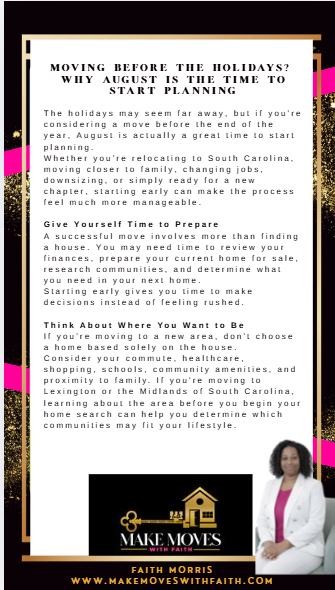
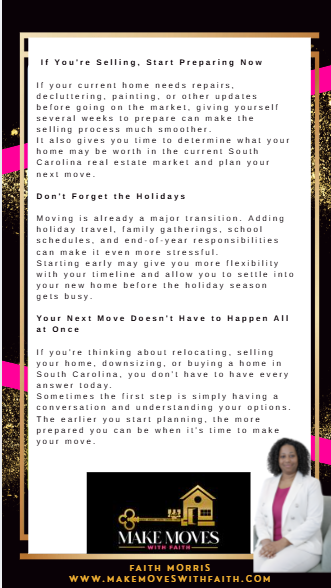
Moving Before The Holidays? Why August is the Time to Start Planning

Learning About Real Estate • August 14, 2026

Back to School Home Organization: Is Your Home Working for Your Family?